
Fulldome in the UK: A Snapshot of a Medium on the Move
Two years ago, I helped research and write a report on a medium most people still struggle to name. Here is what has changed since.
INDUSTRY
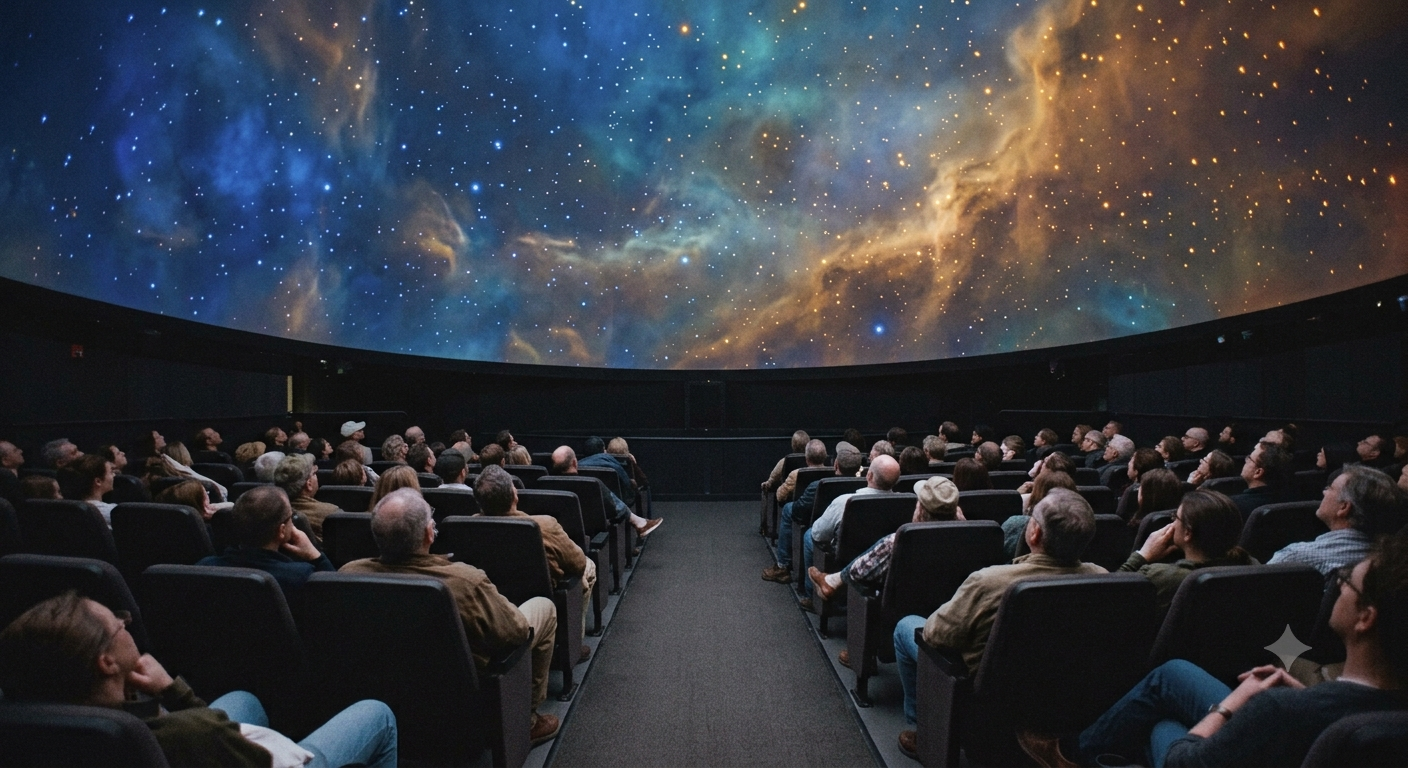
Two years ago, working with Live Cinema UK and funded by Creative UK, I helped research and write Fulldome in the UK, a report mapping a medium most people still struggle to name: 360-degree projected moving image wrapped right around an audience, with surround sound, inside a dome. Not a film on a flat screen in front of you, but an environment you sit inside.
We set out to answer some surprisingly unanswered questions. What cultural content already exists for fulldome, beyond the space and science shows planetariums are built for? What's the language, the licensing, the routes to market? And why should the UK be backing this medium now?
Our argument, in short: the UK is sitting on a quiet wealth of advantage. World-class artists and technical talent. Two of the very few purpose-built cultural fulldome venues anywhere in the world, CultVR in Cardiff and Market Hall in Plymouth. One of the longest-running fulldome festivals on the planet. And a network of around 30 planetariums that are starting to programme and screen cultural work to new audiences. What was missing wasn't capability. It was funding and distribution pathways for immersive work that falls between the cracks of how we usually fund film, performance or visual art.
Revisiting the report now, what strikes me most is how fast the ground has shifted:
Sphere in Las Vegas has gone from curiosity to one of the world's highest-grossing venues, with a second, $1.7bn Sphere now confirmed for Abu Dhabi, opening around 2029, and a smaller US venue planned near Washington DC.
COSM opened its first LED dome venues in Los Angeles and Dallas in 2024 and is now rolling out across Atlanta, Detroit and Cleveland.
The proposed London Sphere was scrapped, which, to me, only sharpens the UK opportunity. Our route to giving audiences this experience runs through planetariums and cultural domes, not a single mega-venue.
The funding gap we flagged is starting to close. The £6m Immersive Arts programme, backed by Arts Council England, the AHRC and the national arts councils, has since supported 225 artist-led projects across the UK, with its first round alone drawing more than 2,500 applications. That oversubscription tells you everything about the pent-up demand.
And closer to home, CultVR and 4Pi's new fulldome film The Rift, a Wales-Zimbabwe collaboration, premiered at IDFA and has been winning right across the international dome circuit: Best Musical Short Film at Dome Fest West in the US, the Grand Prize at Paris's NewImages Festival and both an Excellence Award and the Audience Award at the IPS Fulldome Festival in Fukuoka. Fulldome UK returns to Cardiff this October.
The core finding still holds: this is a timely, under-supported moment and the UK is unusually well-placed to lead it. The medium is becoming legible to mainstream audiences, partly thanks to those headline venues, at exactly the point our existing planetaria are looking to diversify their programming and reach new audiences, as well as visitor attractions and corporate clients amazed by the power of the dome.
If you're an attraction, business, artist, live performer, VR/360 creator, planetarium, festival or funder curious about what the dome could do for your work, I'd love to talk
Share


© 2026 Ruth Coalson. All rights reserved.